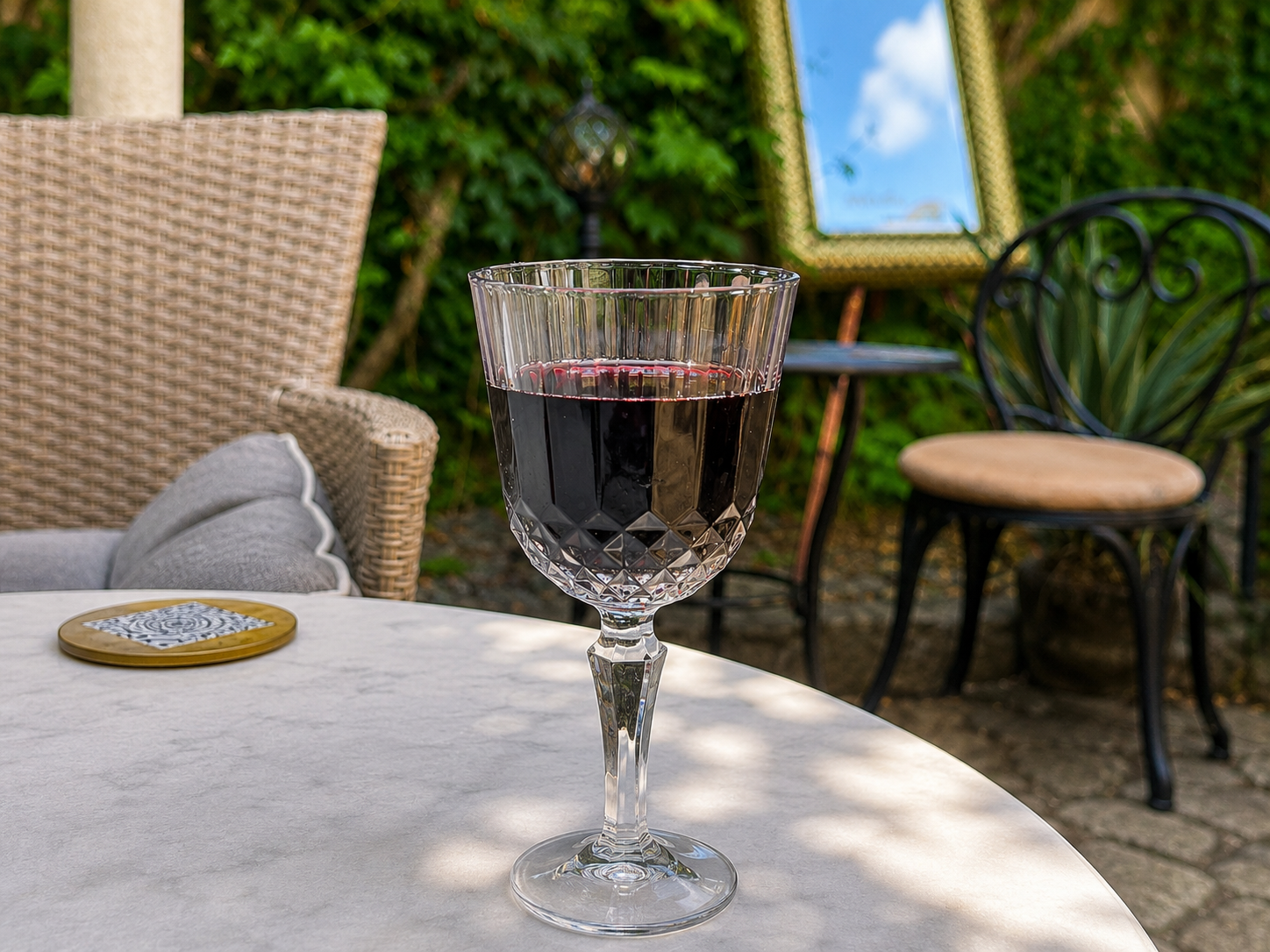
Există o oră, spre seară, în care cafeaua se retrage discret și lasă locul altui ritual. Lumina coboară oblic peste curtea Casei Tătărescu, teii se înmoaie în auriu, conversațiile încetinesc — și ceașca de cafea de dimineață pare, dintr-odată, dintr-o cu totul altă viață. Pentru acel moment, lista de vinuri a Art Deco Café este gândită ca o mică hartă: câteva soiuri autohtone cu poveste, câteva case italiene cu istorie și destule bule cât să marcheze o ocazie. Iată cinci vinuri pentru o seară la cafenea, alese nu după modă, ci după cum se așază în atmosfera unei curți de epocă.
Înainte de orice recomandare, un principiu: seara la cafenea cere vinuri de conversație, nu de degustare solemnă. Vinuri care se beau pe îndelete, care însoțesc o discuție fără să o domine, care merg la fel de bine singure ca lângă o felie de chec. Cele cinci de mai jos acoperă, împreună, întreaga seară — de la primul pahar până la cel care cere un toast.
1. Albul cu care deschizi seara — Zghihară de Averești
Dacă seara are nevoie de un început proaspăt, puține vinuri românești îl dau mai bine decât Zghihara de Huși. Este un soi autohton vechi, cunoscut în podgoria Hușilor încă dinainte de filoxeră, cultivat astăzi de Domeniile Averești sub eticheta Nativus. Caracteristica lui inconfundabilă este aciditatea ridicată — depășește constant 6 grame pe litru —, care îi dă o prospețime tăioasă, cu arome de mere verzi și note citrice.
Tocmai această aciditate îl face un aperitiv ideal. Un pahar de Zghihară rece trezește papilele și pregătește seara, exact cum face o lămâie stoarsă peste o farfurie. Îl alegi când vrei un alb sec, viu, deloc dulceag — și când vrei să bei ceva ce nu vei găsi în nicio carte de vinuri internațională. Pentru băutorul curios, Zghihara este și o mică lecție de patrimoniu: gustul unei Românii vinicole de dinainte de soiurile la modă.
2. Rozeul unui domeniu princiar — Corcova
Când lumina e încă blândă și nu te-ai hotărât între alb și roșu, un rosé rezolvă dilema. Corcova, din Mehedinți, vine cu un bonus pe care puține vinuri îl au: o poveste cu gust. Domeniul este atestat documentar din secolul al XVI-lea, iar la începutul anilor 1900 a aparținut prințului Anton Bibescu și soției sale, care au ridicat în 1910 o cramă cu cuve de ciment folosite și astăzi. După decenii de declin, podgoria a fost readusă la viață printr-un proiect româno-francez, cu soiuri nobile replantate pe vechiul teroar.
Un rosé de Corcova este alegerea serilor de terasă, când vrei un vin sec, parfumat, cu fructuozitate fină, dar fără greutate. Merge cu ora aurie a curții, cu o conversație ușoară, cu o seară care nu cere angajamente. Îl recomanzi cuiva care vrea „ceva bun și nu prea tare" — și care apreciază, în plus, că în pahar se află un strop de istorie boierească.
3. Roșul de care nu te plictisești — Fetească Neagră
Niciun ghid de vinuri românești nu este complet fără Fetească Neagră, soiul roșu emblematic al țării și unul dintre cele mai vechi din podgoriile noastre. Pe lista Art Deco Café apare în mai multe variante — de la Budureasca la Averești Nativus —, ceea ce înseamnă că poți alege intensitatea după dispoziție: de la o versiune mai rotundă, demisecă, la una sobră, seacă.
Fetească Neagră este roșul de conversație prin definiție: are corp, dar nu copleșește, cu arome de prune uscate, vișine și un fundal ușor condimentat. Se bea bine și fără mâncare, ceea ce îl face perfect pentru o seară la cafenea, unde rar comanzi un fel complet. Îl alegi când seara s-a așezat, când lumina s-a stins și vrei un vin care ține pasul cu o discuție lungă. Este, dintre toate cele cinci, cel mai „de acasă" — și tocmai de aceea, cel mai reconfortant.
4. Puntea italiană — Piccini Chianti DOCG
Cafeneaua are un suflet italian, fiindcă italiană este și cafeaua din ceașcă. De aceea, un Chianti DOCG de la Casa Piccini se așază firesc pe listă. Detaliul care leagă totul este anul: Piccini a fost fondată în 1882 la Poggibonsi, în inima Toscanei — exact anul în care, în Piemont, lua naștere și torefactorul Caffè Vergnano. Două case italiene de aceeași vârstă, una a cafelei, alta a vinului, întâlnindu-se peste un secol și jumătate în aceeași curte din "Micul Paris".
Chianti-ul Piccini este construit predominant pe Sangiovese, soiul-rege al Toscanei, cu aciditate vie, taninuri prietenoase și arome de cireșe și ierburi mediteraneene. Îl alegi când vrei un roșu cu personalitate sudică, ceva mai elegant decât un vin de fiecare zi, dar fără solemnitatea unei rezerve scumpe. Este vinul serilor în care vrei să te simți, pentru o oră, pe o terasă din Chianti — fără să pleci din Sectorul 1.
5. Bulele de final — Mionetto Prosecco
Orice seară care merită ținută minte cere, la un moment dat, bule. Mionetto Prosecco vine din dealurile Valdobbiadene, leagănul Prosecco-ului și astăzi sit UNESCO, unde casa a fost fondată în 1887. Făcut din strugure Glera, este un spumant proaspăt, floral, cu o efervescență fină — exact ce cere un toast spontan sau pur și simplu dorința de a transforma o seară obișnuită în una specială.
Prosecco-ul este alegerea democratică a sărbătorii: ușor, vesel, niciodată pretențios. Pentru ocaziile cu adevărat mari, lista merge însă mai departe, până la singura șampanie din meniu — un Moët & Chandon Brut Impérial, pentru aniversări, cereri în căsătorie sau victorii care nu se mulțumesc cu mai puțin. Restul detaliilor — soiuri, case, podgorii — se văd, pentru cine vrea să aleagă pe îndelete, în meniul Art Deco Café.
Cum alegi, până la urmă
Cea mai bună listă de vinuri nu este cea cu cele mai scumpe etichete, ci cea care urmează firul unei povești. Începe cu un alb viu cât e încă lumină, treci la un rosé sau la un roșu blând când conversația se așază, oprește-te la un Chianti dacă vrei greutate sudică și încheie cu bule dacă seara o cere. Aceste cinci vinuri pentru o seară la cafenea sunt mai degrabă un traseu decât un clasament — fiecare are ora lui.
Le găsești pe toate la Art Deco Café, în curtea Casei Tătărescu, monument istoric din 1935 readus la viață ca EkoGroup Vila, pe Strada Polonă 19, în Sectorul 1 al Bucureștiului. Pentru rezervări sau pentru o seară aparte, sună la 0771 303 303 sau scrie la office@ekogroup.ro; lista completă se vede oricând în meniul cafenelei, iar atmosfera curții la apus se urmărește pe Instagram, TikTok și YouTube. Despre cocktailuri — altă dată, la alt pahar.
There is an hour, towards evening, when coffee quietly retreats and makes way for another ritual. The light falls at an angle across the courtyard of Casa Tătărescu, the linden trees soften to gold, conversations slow down — and the morning coffee cup suddenly seems to belong to an entirely different life. For that moment, the wine list at Art Deco Café has been conceived as a small map: a few indigenous varieties with a story, a few Italian houses with history, and enough bubbles to mark an occasion. Here are five wines for an evening at the café, chosen not by fashion but by how well they settle into the atmosphere of a period courtyard.
Before any recommendation, one principle: an evening at the café calls for wines of conversation, not solemn tasting. Wines that are drunk at leisure, that accompany a discussion without dominating it, that work as well alone as alongside a slice of cake. The five below cover the whole evening together — from the first glass to the one that calls for a toast.
1. The White That Opens the Evening — Zghiharǎ de Averești
If an evening needs a fresh beginning, few Romanian wines deliver it better than Zghihara de Huși. It is an old indigenous variety, known in the Huși wine region since before the phylloxera, cultivated today by Domeniile Averești under the Nativus label. Its unmistakable characteristic is a high acidity — consistently above 6 grams per litre — which gives it a sharp freshness, with aromas of green apple and citrus notes.
It is precisely this acidity that makes it an ideal aperitif. A cold glass of Zghiharǎ wakes the palate and prepares the evening, just as a squeezed lemon prepares a plate. Choose it when you want a dry, lively white with no sweetness — and when you want to drink something you will not find in any international wine guide. For the curious drinker, Zghihara is also a small lesson in heritage: the taste of a Romanian wine culture that predates fashionable varieties.
2. The Rosé of a Princely Estate — Corcova
When the light is still gentle and you have not decided between white and red, a rosé resolves the dilemma. Corcova, from Mehedinți, comes with a bonus few wines possess: a story with flavour. The estate is documented from the sixteenth century, and in the early 1900s it belonged to Prince Anton Bibescu and his wife, who built a winery in 1910 with concrete vats still in use today. After decades of decline, the vineyard was brought back to life through a Romanian-French project, with noble varieties replanted on the old terroir.
A Corcova rosé is the choice for terrace evenings, when you want a dry, fragrant wine with delicate fruitiness and no heaviness. It goes with the golden hour of the courtyard, with easy conversation, with an evening that asks for no commitments. Recommend it to someone who wants "something good and not too strong" — and who will appreciate, moreover, that the glass holds a drop of aristocratic history.
3. The Red You Won't Tire Of — Fetească Neagră
No guide to Romanian wines is complete without Fetească Neagră, the emblematic red variety of the country and one of the oldest in our vineyards. On the Art Deco Café list it appears in several versions — from Budureasca to Averești Nativus — which means you can choose the intensity to match your mood: from a rounder, off-dry version to a sober, dry one.
Fetească Neagră is the conversation red by definition: it has body but does not overwhelm, with aromas of dried plums, morello cherries and a lightly spiced finish. It drinks well without food, which makes it perfect for an evening at the café where you rarely order a full meal. Choose it when the evening has settled, when the light has faded and you want a wine that keeps pace with a long discussion. Of these five, it is the most "at home" — and for precisely that reason, the most comforting.
4. The Italian Bridge — Piccini Chianti DOCG
The café has an Italian soul, because Italian is also the coffee in the cup. For that reason, a Chianti DOCG from Casa Piccini sits naturally on the list. The detail that ties everything together is the year: Piccini was founded in 1882 in Poggibonsi, in the heart of Tuscany — the exact year in which, in Piedmont, the Caffè Vergnano roastery was also born. Two Italian houses of the same age, one of coffee and one of wine, meeting a century and a half later in the same courtyard in "Little Paris".
Piccini Chianti is built predominantly on Sangiovese, Tuscany's king grape, with lively acidity, friendly tannins and aromas of cherries and Mediterranean herbs. Choose it when you want a red with a southern personality — slightly more elegant than an everyday wine, but without the solemnity of an expensive reserve. It is the wine for evenings when you want to feel, for an hour, as though you are on a Chianti terrace — without leaving Sector 1.
5. The Closing Bubbles — Mionetto Prosecco
Any evening worth remembering calls for bubbles at some point. Mionetto Prosecco comes from the hills of Valdobbiadene — the cradle of Prosecco and now a UNESCO site — where the house was founded in 1887. Made from Glera grapes, it is a fresh, floral sparkling wine with fine effervescence — exactly what a spontaneous toast requires, or simply the wish to turn an ordinary evening into a special one.
Prosecco is the democratic choice for celebration: light, cheerful, never pretentious. For truly grand occasions, the list goes further, all the way to the only Champagne on the menu — a Moët & Chandon Brut Impérial, for anniversaries, proposals or victories that will settle for nothing less. The remaining details — varieties, houses, regions — can be explored at leisure in the Art Deco Café menu.
How to Choose, When It Comes to It
The best wine list is not the one with the most expensive labels, but the one that follows the thread of a story. Start with a lively white while the light holds, move to a rosé or a gentle red as the conversation settles, pause at a Chianti if you want a southern weight, and close with bubbles if the evening calls for it. These five wines for an evening at the café are more of a route than a ranking — each one has its hour.
You will find them all at Art Deco Café, in the courtyard of Casa Tătărescu — a listed historic monument from 1935, brought back to life as EkoGroup Vila — at 19 Polonă Street, Sector 1, Bucharest. For reservations or a special evening, call 0771 303 303 or write to office@ekogroup.ro; the full list is always in the café menu, and the courtyard atmosphere at sunset is captured on Instagram, TikTok and YouTube. Cocktails — another time, with another glass.